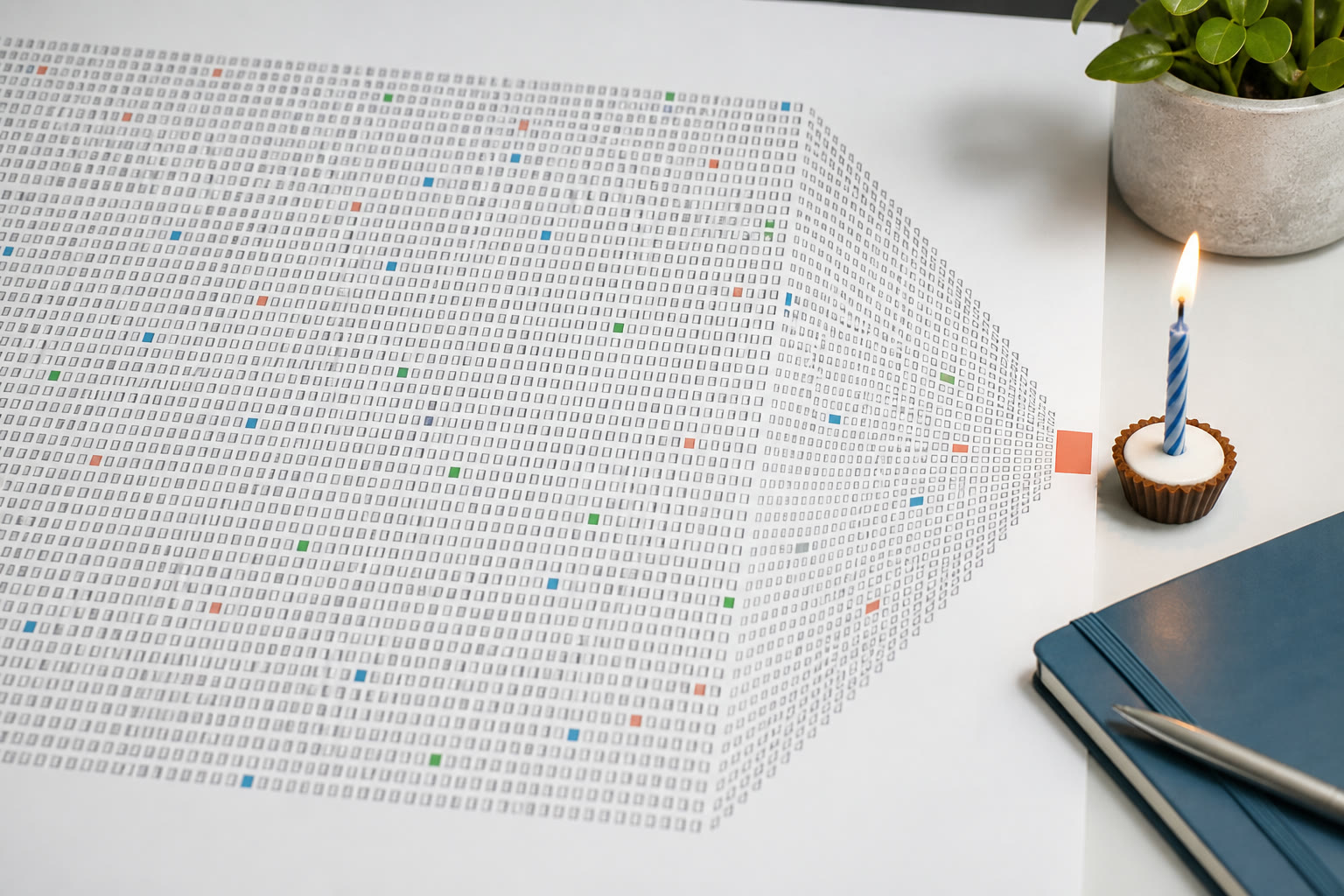
A 10,000-day birthday is found by adding 10,000 elapsed days to the birth date. Clear endpoint rules matter because counting the birth date as day one produces a different celebration date.
The standard elapsed-day rule
At the instant of birth, zero full days have elapsed. One day later, the person is one day old. Under this convention, the 10,000-day milestone is the birth date plus 10,000 calendar days.
A list that labels the birth date as day one reaches its ten-thousandth counted date one day earlier. That can be useful for ordinal schedules, but it should not be confused with being 10,000 complete days old.
Why adding years is unreliable
Ten thousand divided by 365 is about 27.4 years, which gives a rough age but not a date. Leap days within the interval depend on the birth date and calendar path.
Add the day amount through date arithmetic instead. A date-only implementation should normalize the values so daylight-saving clock changes do not create a missing or duplicate calendar day.
A simple verification
After calculating the milestone date, subtract the birth date using the same elapsed-day method. The result should be exactly 10,000. Also check the day before and day after; they should return 9,999 and 10,001.
Test February births, leap years, and dates near a daylight-saving transition. These examples expose the common error of dividing local timestamp milliseconds by a fixed day length.
Using a countdown
Once the milestone date is in the future, a countdown can show the remaining date gap. Decide whether today and the event date are included before sharing the number, because a calendar countdown and a list of occupied dates use different rules.
For a gathering, save the actual date and local start time. A downloaded result is a snapshot, not a live reminder, so a calendar event is more reliable for invitations.
Privacy and presentation
A public milestone announcement can reveal approximate age even when it omits the birth date. Consider whether the audience needs the number, date, or only the celebration message.
Keep calculation inputs in the browser, verify the date independently, and share only the final detail needed. An accurate milestone is most useful when its counting convention is clear and its personal data remains proportionate.
Calculate the date without averaging years
The correct method adds 10,000 calendar days to the normalized birth date. Dividing by 365 gives a useful sense of scale, roughly 27 years and several months, but it cannot identify the anniversary because leap days occur at irregular calendar positions. Date arithmetic should count actual Gregorian dates rather than use an average-year conversion.
A date-only milestone normally treats the birth date as day zero, so one day old is the following date. Some keepsake traditions count the birth date as day one. A calculator should state its convention because the two approaches differ by exactly one day. The elapsed-day convention is generally easier to compare with age-in-days results.
Leap years and local clock changes
Leap days are naturally included when a calendar library adds days. Daylight-saving changes should not alter a date-only result, because the question counts calendar dates rather than groups of 24 local hours. Normalizing the input as a date prevents a 23-hour spring day from creating an off-by-one error.
If the user wants the exact 10,000-times-24-hour instant, a birth timestamp and timezone are required. That result can have a different local clock time from the original birth time after offset changes. Label it as an elapsed-hour milestone, not the ordinary date on which the person becomes 10,000 days old.
Verify and celebrate without oversharing
Check the birth date, day-zero convention, and target total. Confirm the result by calculating the exact elapsed-day difference back to the input. Test a February 29 birth and dates spanning century years such as 2000 or 2100. These cases establish that the leap-year rule is implemented correctly.
When sharing the milestone, omit the full birth date if it is not necessary. A message such as I reach 10,000 days on Saturday communicates the event without exposing the source data. The calculator can run locally, but screenshots and downloaded cards leave the browser and should contain only information the user intends to publish.
A worked example and countdown plan
For a real calculation, enter the date exactly as recorded, select elapsed-day counting, and add 10,000 days. The output should provide the milestone date, weekday, current status, and days remaining or elapsed. It can also show the approximate calendar age as context, while keeping that approximation separate from the exact date addition. Reversing the calculation should return a 10,000-day gap.
If the milestone is upcoming, create a reminder from the final date rather than from the approximate age. Check the result again after moving it into another calendar application, because imported events may inherit a timezone even when the original calculation was date-only. An all-day event is usually the clearest format for a day-count celebration.
The same method works for a child, historical figure, project, organization, or relationship date, provided the chosen starting date has a clear meaning. Keep the label accurate: a founding date is not a birthday, and a date known only approximately cannot support an exact milestone claim. Precision in language is part of precision in calculation.
Common errors to avoid
Do not add 27 years and a guessed number of months, count the birth date as both day zero and day one, or convert local midnights through a timezone before date-only subtraction. Each shortcut can move the result. Use calendar-day addition with one stated convention and let the calendar rules include leap dates.
Do not describe the milestone as a guaranteed celebration date when the source birth date is uncertain or uses another calendar without conversion. Confirm that the entered date is Gregorian or convert it through a reliable calendar-specific method first. The cleanest output is a reproducible date paired with a short explanation, not an unsupported claim of universal exactness.
Key takeaway
Add 10,000 normalized calendar days to the recorded Gregorian birth date under a visible day-zero convention. Do not approximate the date from 365-day years, and do not let daylight-saving timestamps interfere with a date-only question. Verify the result by subtracting the two dates, then save it as an all-day event if planning a celebration. State any uncertainty in the source date and avoid publishing the full birthday when the milestone date alone is enough. The same clear method can support other custom day landmarks without filling the page with arbitrary or duplicate results.
Sources and further reading
These references support the calendar rules, cultural context, or public-data definitions discussed in this guide.
- U.S. Naval Observatory: CalendarsReference for Gregorian calendar structure and leap years.
- ISO: Date and time formatGuidance for recording milestone dates unambiguously.