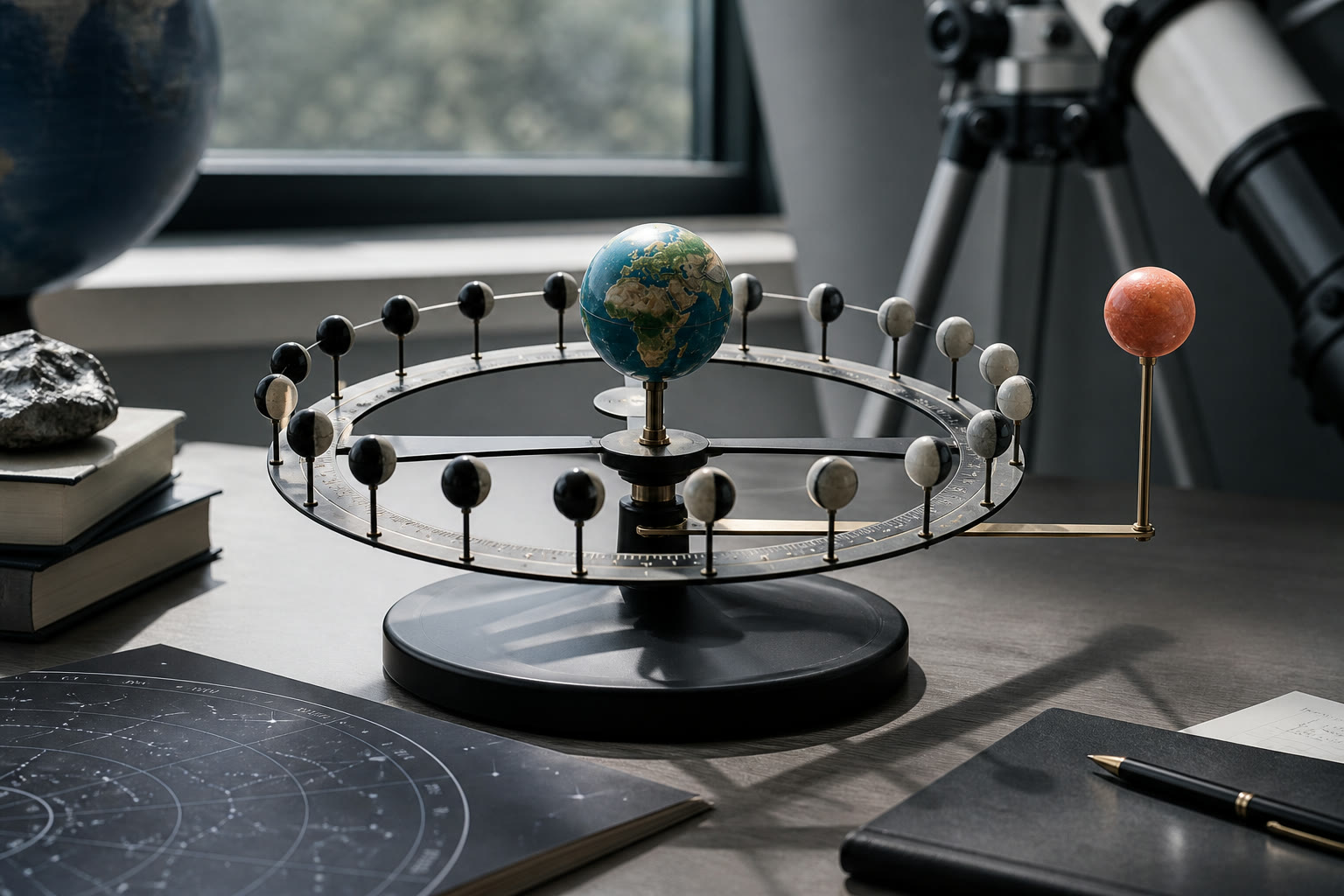
The Moon returns to the same position relative to the stars faster than it returns to the same phase relative to the Sun. Those two reference frames produce different month lengths.
The sidereal month
A sidereal month measures the Moon's orbit relative to distant stars. Its average length is about 27.32 days. Imagine marking the Moon's direction against the background sky and waiting for it to return to that direction.
This period is useful for orbital comparisons. A lifetime Moon-orbit counter commonly divides elapsed time by this average, while clearly labeling the result as an estimate.
The synodic month
A synodic month measures the cycle of lunar phases, such as full Moon to full Moon or new Moon to new Moon. Its average length is about 29.53 days.
The phase cycle is longer because Earth moves along its orbit around the Sun while the Moon orbits Earth. The Moon must travel farther than one star-relative circuit to restore the same Sun-Earth-Moon alignment.
Why the totals differ
Over one year, dividing by 27.32 produces more orbital cycles than dividing by 29.53 produces phase cycles. A calculator that shows Moon orbits and full moons should therefore return different totals by design.
Calling both values months without the reference frame creates confusion. Use sidereal orbit and synodic phase cycle in labels, and display the average period beneath each number.
Average periods and real motion
The Moon's orbit is not a perfect circle and its speed varies. Perturbations and the precise definition of a phase event mean individual intervals differ around the average.
A birth-date calculator is not reconstructing an ephemeris for every moment lived. Dividing by published averages is appropriate for scale, provided the page does not label the result as an exact count of observed full moons.
A worked comparison
For 10,000 elapsed days, the average calculation gives roughly 366 sidereal orbits and 339 synodic phase cycles. Rounding should reflect that the periods are averages rather than exact personal observations.
The result can be verified by dividing the same elapsed-day total by each published period. Using one common numerator makes the reason for the difference easy to inspect.
Using lunar comparisons responsibly
Moon-cycle totals can make a lifetime duration more tangible and support astronomy learning. They do not determine personality, health, fertility, or future events.
Keep astronomy and cultural symbolism clearly separated. When an exact lunar phase for a historical timestamp matters, use an astronomical ephemeris or observatory source instead of an average-period counter.
The reference point changes the month
A sidereal month measures the Moon's orbit relative to distant stars. A synodic month measures the interval from one repeated phase, such as new moon to new moon, as seen from the moving Earth. Because Earth advances around the Sun while the Moon orbits Earth, the Moon must travel farther before the same Sun-Earth-Moon geometry returns.
That is why the synodic month is longer than the sidereal month. Neither is a replacement for a civil calendar month, whose length follows calendar rules. A life-statistics tool should label lunar cycles as approximate astronomical equivalents instead of calling them the user's exact age in months.
Phases are not equal quarter-month blocks
The familiar sequence of new moon, first quarter, full moon, and last quarter does not divide every lunation into perfectly equal durations. Orbital speed varies, and observational times are calculated from geometry. Dividing a mean synodic month by four is a rough teaching aid, not an ephemeris for a specific location and date.
If the page shows phases during a lifetime, it should use an astronomy data source or established library for dated events. A simple count can estimate how many mean synodic months elapsed, while exact phase timing belongs to a separate calculation with time standards and location-dependent display choices.
How to estimate lifetime lunar cycles
Convert elapsed time to days and divide by the published mean length of the chosen lunar month. Keep the result labeled as an equivalent cycle count. A rounded whole number can show completed mean cycles, while a decimal illustrates progress through another average interval. Do not imply that the person's birth phase repeats at each mean boundary.
The start and end timestamps, time standard, and selected mean all affect fine precision. For a date-only birth input, a result rounded to a sensible level is more appropriate than many decimal places. Cite the astronomical source and state whether the display uses sidereal or synodic cycles.
Cultural calendars need separate treatment
Lunar and lunisolar calendars use rule systems that are more complex than dividing days by a mean month. Month starts can depend on calculated or observed events, and leap months keep a calendar aligned with seasons. A mean synodic count should not be presented as a date conversion for Chinese, Islamic, Hebrew, or other calendars.
Use the astronomy statistic for educational comparison, then link to a calendar-specific authority when users need a cultural or religious date. Keeping those purposes separate avoids flattening distinct traditions into one generic moon calculator and produces a clearer, more respectful result.
A numerical comparison with honest rounding
Using commonly published mean values, the synodic cycle is roughly 29.53 days and the sidereal orbit roughly 27.32 days. Across one solar year, dividing by these means gives different equivalent cycle counts because the reference alignments differ. The calculation does not show that the Moon changes speed to fit two months; it shows that two observers are waiting for different geometric conditions to repeat.
For a lifetime display, round the values enough to communicate scale and retain the exact constants and citations in the method. Do not update a live counter as though a mean cycle boundary were an observed phase event. If a user wants the next full moon, call an ephemeris or astronomy library designed for dated phase calculations.
Test the unit conversion from milliseconds or seconds to days and verify that both counts use the same elapsed interval. Label the results lunar orbits relative to stars and phase cycles relative to the Sun-Earth geometry. A precise name prevents an attractive astronomy card from teaching the wrong definition.
Reading the two results together
A larger synodic-day value produces fewer phase cycles than sidereal orbits over the same elapsed time. That relationship is expected. If a tool shows the opposite, check that the constants were not swapped and that both formulas divide the same elapsed-day total. A one-line comparison can help users notice the difference without requiring an astronomy background.
Keep astrology and cultural symbolism outside the astronomical result unless they are presented in a clearly separate, appropriately sourced section. Orbital periods are measurable physical definitions. Mixing them with personality claims or calendar traditions on one unlabeled card would reduce clarity and make it harder for readers to know which statements are scientific measurements.
Key takeaway
Sidereal and synodic months measure different repeating geometry: an orbit relative to distant stars and a phase cycle relative to the Sun and Earth. Use the same elapsed-day interval, divide by clearly cited mean periods, and label the outputs as approximate equivalent cycles. Do not turn a mean boundary into an exact dated moon phase or a cultural-calendar conversion. Exact phases require astronomy calculations, while religious and cultural dates require their own calendar rules. Keeping those scopes separate lets a simple lifetime comparison teach a real astronomical distinction without overstating precision. Cite the mean values so readers can reproduce both divisions independently. A formula line should identify elapsed days as the common numerator.
Sources and further reading
These references support the calendar rules, cultural context, or public-data definitions discussed in this guide.
- NASA: Eclipses and the Moon's orbitDefinitions and average lengths for sidereal and synodic lunar periods.
- NASA Science: Moon factsGeneral scientific context for the Moon's orbit and rotation.