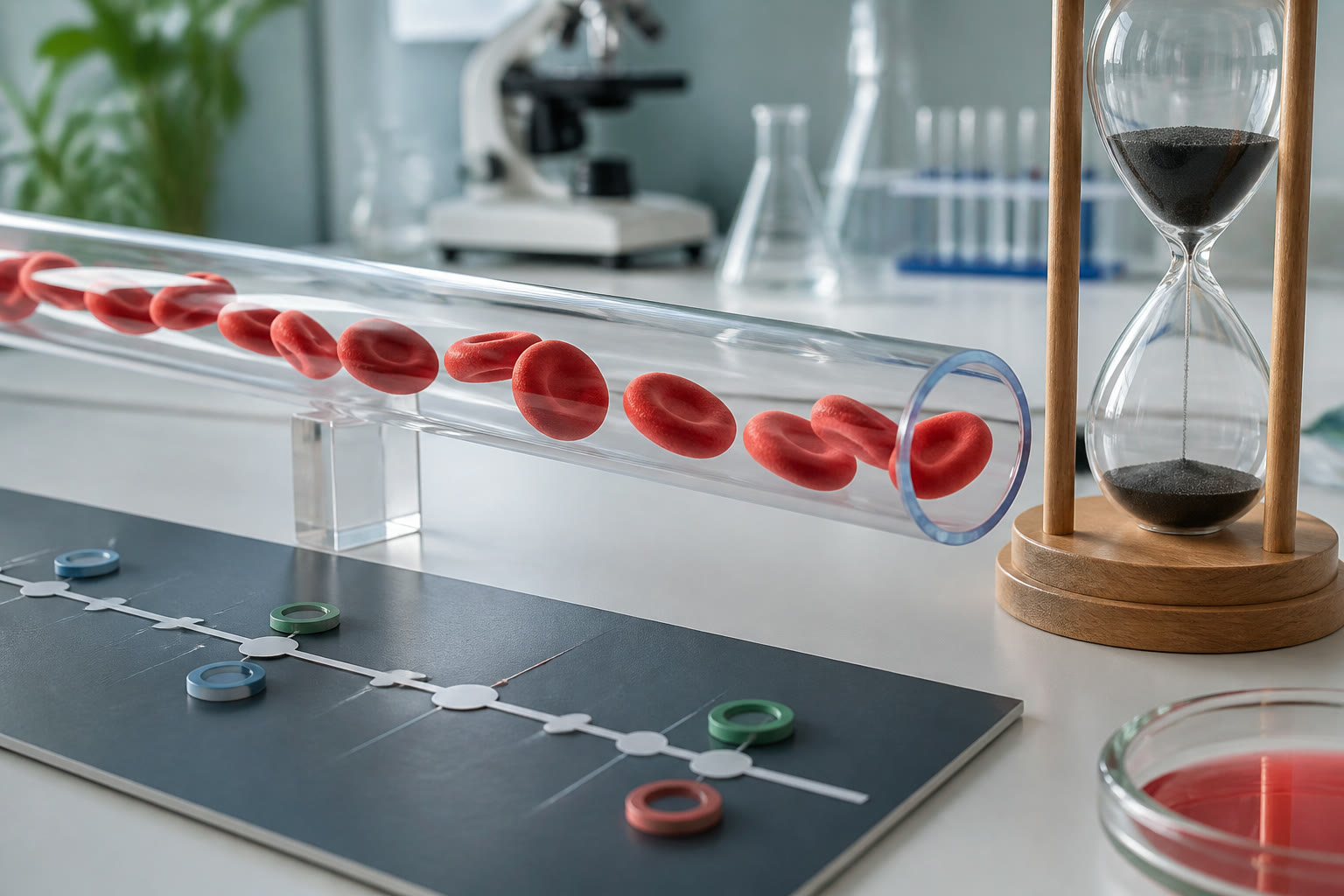
Red blood cells are continually produced and removed. A lifetime counter multiplies elapsed seconds by a broad production-rate assumption, creating an educational scale estimate rather than a personal laboratory result.
Why the body produces so many cells
Red blood cells circulate for a limited period and are continually replaced. Maintaining the circulating population requires production on an enormous scale, so even a per-second assumption quickly becomes a very large lifetime number.
The educational value is scale. The counter is not counting cells in the visitor's body and cannot know how production changed during growth, illness, pregnancy, altitude exposure, treatment, or other conditions.
The rate-based formula
Choose a published broad rate, multiply it by elapsed seconds, and label the product estimated. If a source describes approximately two million cells per second, every displayed digit beyond the precision of that phrase remains illustrative.
A live animation can add the rate as time advances, but it still reflects arithmetic. Reopening the page should recalculate from elapsed time rather than pretend the browser observed cellular events while it was closed.
Production is regulated
Bone marrow production responds to oxygen needs and physiological signals. Nutrition, kidney function, marrow health, blood loss, medications, and many other factors can affect the process.
Because those variables are absent from a birth-date form, the page should not personalize the rate or compare the result with a normal range. A broad source value is appropriate only for general education.
Produced cells are not the current blood count
A lifetime production total accumulates replacement events. It is fundamentally different from the number of cells circulating now, a complete blood count, hemoglobin concentration, or hematocrit.
Someone cannot infer anemia, blood volume, fitness, or disease from the counter. Those questions require laboratory measurement and clinical interpretation, not a cumulative multiplication.
Handling precision honestly
Display the rate, use words such as about and estimated, and round the total to a readable scale when appropriate. Scientific notation can help explain magnitude without implying that every final digit is known.
Citing a biological source beside the assumption is more important than making the counter visually dramatic. The methods note should be visible on the result, copied text, and downloaded card.
What the estimate is for
Use the estimate to explore turnover, large-number scale, and the difference between a production rate and a current stock. It can support a classroom discussion when the assumptions remain attached.
Do not use it for symptoms, diagnosis, treatment, donation eligibility, or nutrition decisions. Direct health questions to a qualified professional and keep medical records out of a general calculator form.
Adult-rate equivalents and childhood
A frequently cited production rate usually describes adult steady-state physiology. Applying that single rate to every second since birth creates an adult-rate equivalent for the elapsed period; it does not claim that an infant, child, and adult produced cells at one unchanged pace.
This distinction belongs beside the result because a longer decimal cannot repair a simplified biological assumption. A useful calculator identifies the cited rate, states that it has been extended across the whole interval, and lets readers understand why the total is an illustration of scale rather than a reconstructed personal history.
Rate, duration, and unit discipline
Start with a cited population-level rate expressed in cells per second or per day. Convert the user's elapsed time to the same unit before multiplication, and preserve enough numeric precision internally to avoid rounding errors. Display the result with grouping or scientific notation so the magnitude is readable without implying that every digit is measured.
If the source describes adult production, do not silently apply it as a known rate during childhood. The tool can call the result an adult-rate equivalent across the elapsed period, or use a clearly described simplified lifetime assumption. Adding a label is more truthful than constructing unsupported age-specific values.
A live animation is not a body sensor
A counter can advance according to the chosen cells-per-second rate after the initial estimate. It does not observe bone marrow, blood tests, oxygen levels, or the visitor's health. The motion represents an estimated production model and should never be read as normal or abnormal status.
Large production rates are usually shown in rounded groups because counting every modeled cell individually would add meaningless visual precision. If the page was inactive, the number may catch up from elapsed time when reopened. Neither behavior changes the underlying assumption or turns the estimate into a measurement.
Medical boundaries
Red blood cell production is related to complex physiology, and actual clinical questions use laboratory measurements and professional interpretation. A date-based estimate cannot diagnose anemia, polycythemia, marrow disorders, oxygen problems, or treatment response. Symptoms and test results should not be interpreted through the lifetime counter.
Use the number to explore scale and biological turnover. Include the rate, source context, and calculation date when sharing it. Remove the full birth date if it is not needed. The result remains interpretable only when the multiplication and its limitations stay attached.
How to check a huge-number result
Write the calculation in stages: elapsed seconds, assumed cells produced per second, and their product. Verify unit conversions independently, especially when a source gives a daily amount. A factor-of-60, 3,600, or 86,400 error can still produce a plausible-looking enormous number, so scientific notation and dimensional labels should remain visible during checking.
Compare the rounded display with a calculation made from the stated rate and elapsed time. A label such as 2.345 quadrillion is readable, but extra unsupported digits would create false precision. Keep the unit and rounding rule with the number so its scale is not mistaken for an exact biological count.
A rate-based range can show sensitivity when it is described as alternative assumptions rather than biological normal limits. The educational conclusion is simply that cellular turnover operates at a scale difficult to picture. Individual production, blood counts, symptoms, and treatment require clinical measurement and professional interpretation.
Testing how sensitive the estimate is
A useful check is to recalculate with a modestly lower and higher illustrative rate. The resulting range shows how strongly the lifetime total depends on the assumption, without presenting those endpoints as a medical normal range or an estimate of the visitor's actual physiology.
For example, changing a two-million-cells-per-second assumption by ten percent changes the lifetime total by ten percent. That relationship is more informative than displaying extra unsupported digits. Keep the elapsed period fixed, record each rate, and compare the rounded totals so readers can see that the model is simple multiplication rather than observation.
Key takeaway
This estimate multiplies elapsed time by a cited illustrative production rate. It does not measure current blood cells, individual marrow activity, or health. Keep the unit, rate, rounding, and adult-rate limitation with the total, and interpret it as cumulative turnover rather than permanent accumulation. A laboratory blood count describes a different quantity at a different moment and should not be compared with this lifetime model. Symptoms, diagnosis, and treatment require clinical measurement and professional interpretation.
Sources and further reading
These references support the calendar rules, cultural context, or public-data definitions discussed in this guide.
- NCBI Bookshelf: Blood and the cells it containsBackground on blood-cell composition, production, and lifespan.
- Merck Manual: Formation of blood cellsPatient-oriented overview of hematopoiesis and blood-cell regulation.