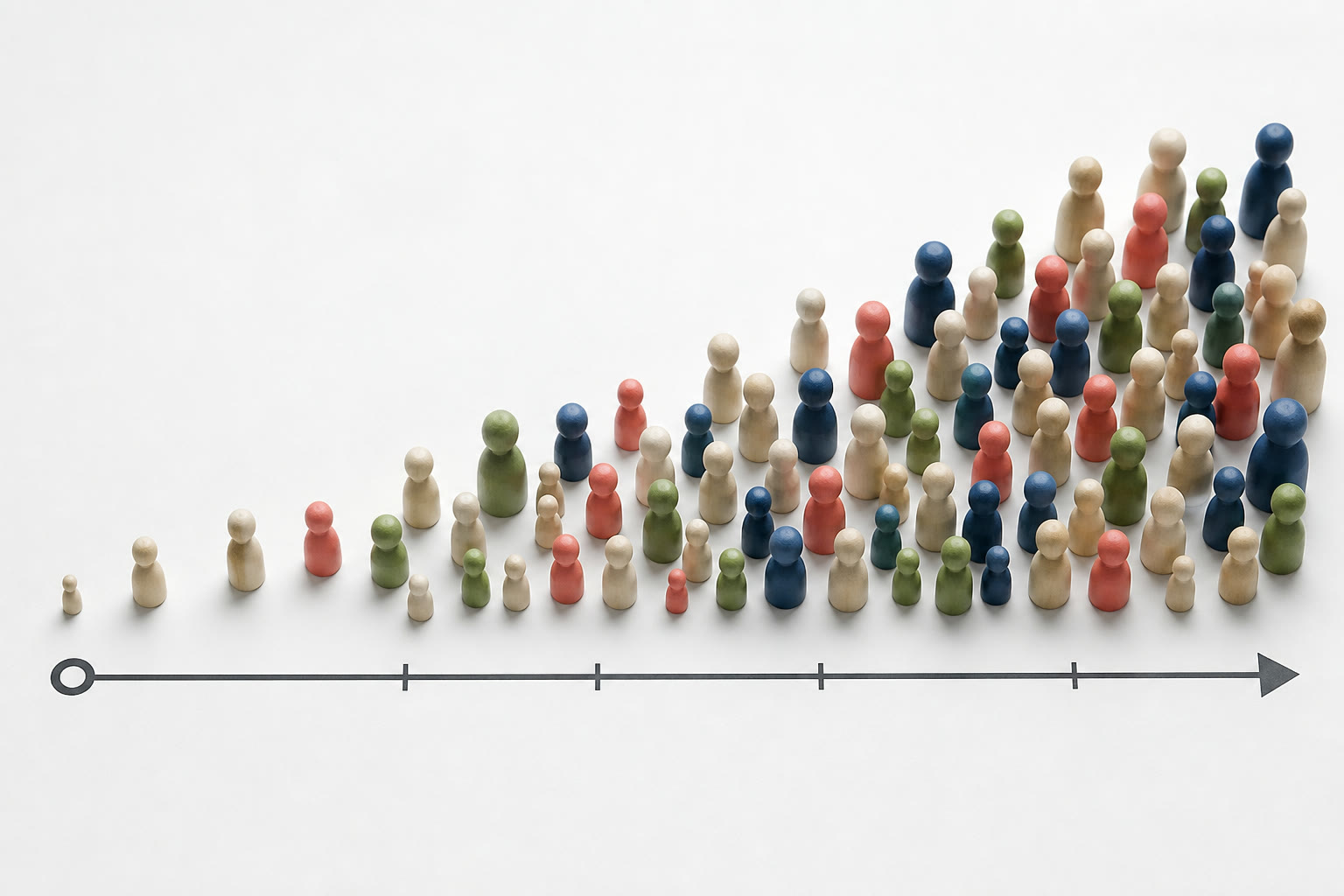
No global registry provides a live exact total for every birth date. The result is estimated from annual population and crude birth-rate series, then distributed across partial years.
Why the number is an estimate
Birth registration systems differ in coverage and publication speed, and there is no public global counter that can answer an arbitrary date exactly. Demographic organizations publish annual estimates instead.
A responsible tool derives a transparent approximation and names the latest source year. The changing counter reflects a modeled rate, not newly received birth certificates.
Estimating births for one year
Multiply annual population by the crude birth rate and divide by 1,000. For example, a population of eight billion and a rate of 16 births per 1,000 implies roughly 128 million births during that year.
Population and rate values may represent annual estimates with their own methods and revisions. Their product should therefore be rounded appropriately rather than displayed as a perfectly known integer.
Handling a birth date inside the year
For the person's birth year, count only the portion after the entered date. A simple method uses the fraction of remaining calendar days and assumes births were distributed evenly across the year.
Real births vary by season and location, so daily interpolation is a convenience. The page should not describe the first-year fraction as a registry count.
Extending beyond the latest observation
Public indicators often end before today. A live estimate may carry forward a recent rate or interpolate toward a maintained projection. That assumption must be identified because the source itself did not publish future daily values.
The stronger approach stores a dated snapshot, separates observed years from modeled continuation, and updates only after reviewing a new release. A live animation should never hide the data boundary.
Different from population growth
People born after a date is a cumulative births total. More people alive now than in the birth year is net population change, which also reflects deaths and migration. The two figures answer different questions.
A births total can be much larger than net growth because many people born during the period are no longer alive. Keep both labels precise and avoid presenting one as proof of the other.
Reading and sharing the result
Use the figure to understand demographic scale and the number of younger birth cohorts, not to rank generations or make claims about individuals. Include source years and estimated wording in copied results.
A month or year can demonstrate the method without exposing a full birth date. When exact personal identification adds no value, reduce the input detail before sharing.
The estimate needs births over time
Current population minus birth-year population does not equal the number of people born afterward. Population change also includes deaths and, for country estimates, migration. A defensible calculation uses annual or period-specific birth totals and sums the births occurring after the user's birth date through the latest available observation.
Annual source gaps require an explicit rule. A calculator may interpolate nearby observations and prorate the first and latest partial years, but it should not silently carry one rate across decades. Direct birth totals are preferable when their scope is complete; otherwise, the output should stay rounded and identify the population and crude-birth-rate series used to estimate missing years.
Handle the first and latest years honestly
A person born midway through a year did not precede every birth reported for that year. If only annual totals exist, prorate the birth year by the fraction remaining and label the result estimated. Births are seasonal, so a uniform daily split is not an observation. The same warning applies when estimating the unfinished current year.
The latest official year often lags behind today. A live counter can project from the most recent annual or daily rate, but reported and projected portions should be separated. Display the last data year and the model used after it. Otherwise animation can make stale source data appear continuously measured.
World and country results answer different questions
A world total estimates births everywhere after the date. A country total depends on the selected territory and does not follow a person who later migrates. Historical borders and missing series can complicate long comparisons. A tool should avoid switching geographic definitions across years without disclosure.
The phrase people younger than you is also not identical to births after you. Some people born afterward have died, and current population age distributions may use modeled estimates. Say births estimated after your date when summing births, and reserve people currently alive and younger for a dataset that supports that separate calculation.
Interpret a very large number
The result gives demographic scale: it places one personal date inside a continuing global timeline. It does not rank lives, measure generations precisely, or identify individual people. Rounding to a suitable magnitude and showing the source years can be more informative than displaying a rapidly changing exact-looking integer.
For reproducibility, save the birth date convention, geography, observed data range, proration rule, and projection method. Keep the full birth date out of shared cards when a birth year or rounded age is enough. Clear definitions protect both statistical meaning and personal privacy.
A simple model you can reproduce
For each complete year after birth, add the published or estimated number of births. Prorate the birth year by the fraction remaining after the selected date. If the latest year is unfinished, include a projected fraction only when it is labeled separately from observed data.
Cross-check annual births derived from population and crude birth rate against a direct births series where both are available. Differences can reveal incompatible populations, units, or timing. Do not treat missing years as zero; any interpolation or carry-forward assumption needs a visible label.
Round the total to a scale supported by the data and label it estimated births after your date. That is not the same as people currently alive, people younger than you, or people personally added to the world. The wording should match the calculation exactly.
Uncertainty that matters
Birth registration completeness and demographic modeling differ across countries and periods. Global series often combine observations with estimates, so a large total should be rounded and described accordingly. An uncertainty note does not make the result useless; it tells the reader what the available data can support.
Avoid adding unrelated population, internet-use, fertility, or income cards simply because the same API provides them. They distract from the personal question. Use those indicators only when a page genuinely explains their relationship. A focused birth estimate with strong definitions is more valuable than a dashboard filled with statistically valid but irrelevant numbers.
Key takeaway
Estimate births after a date by summing a consistent births series, not by subtracting population totals. Prorate partial years only with a visible assumption, separate observed and projected values, and preserve geography and source years. Do not rename births as people currently alive or younger, because deaths and migration make those different measures. Round modeled global values to honest precision and disclose data limitations. A focused result answers the personal timeline question far better than unrelated population indicators, while a privacy-aware share card can omit the full date used to make the estimate. Revisit the model when the provider publishes revised historical birth totals or a newer observed year. Record the prior release so large revisions can be explained rather than appearing as counter errors. Dataset notes should remain available after the animation starts.
Sources and further reading
These references support the calendar rules, cultural context, or public-data definitions discussed in this guide.
- World Bank: Crude birth rateAnnual births per 1,000 people used to estimate global births.
- World Bank: Total populationAnnual population series used with the crude birth rate.
- United Nations: World Population ProspectsDemographic estimates, projections, and methodology.