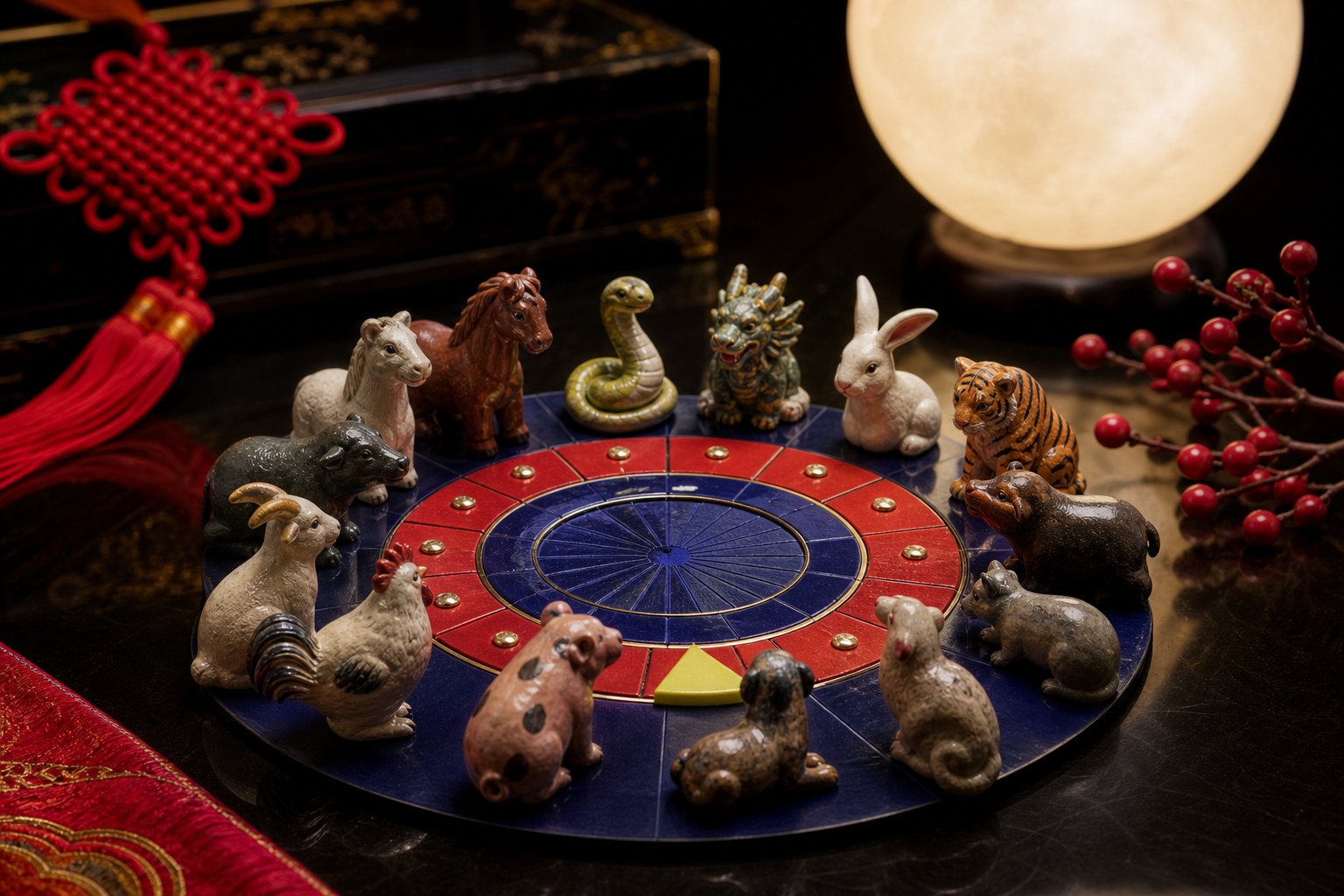
Chinese zodiac years begin on Chinese New Year, not January 1. People born in January or February can belong to the prior zodiac year depending on the lunar calendar boundary.
The year does not start on January 1
Chinese zodiac years change at Lunar New Year, whose Gregorian date varies from year to year. A person born in January or early February may belong to the zodiac animal associated with the previous Gregorian year.
That is why a reliable lookup asks for the full birth date and compares it with a maintained Chinese New Year boundary table.
Animals, elements, and polarity
The familiar twelve-animal cycle repeats every twelve zodiac years. Traditional systems also associate years with one of five elements and with yin or yang, creating a longer repeating pattern.
These labels belong to cultural and astrological traditions. The calculator reports them for reference and entertainment, not as scientific predictions about a person.
Supported date ranges
A boundary table is only as reliable as its covered years. LifeStatistics.net uses verified Chinese New Year dates from 1900 through 2030 and labels dates outside that range as Gregorian-year approximations.
An approximation may assign the wrong animal for births before Lunar New Year. Users outside the supported range should check a trusted lunar calendar source before relying on the result.
Checking a January or February result
First confirm the birth date, then note the Chinese New Year date for that Gregorian year. Births before the boundary use the prior zodiac year; births on or after it use the new one.
Keep cultural context visible when sharing. An animal or element can be a pleasant birthday detail, but it should not be used to judge ability, compatibility, or future outcomes.
Lunar New Year is the essential boundary
Chinese zodiac lookup cannot reliably use the Gregorian year alone because the zodiac year changes at Lunar New Year, not January 1. Lunar New Year falls between late January and mid-February in the Gregorian calendar. Someone born before that boundary belongs to the preceding zodiac year for the purpose of this common lookup. This is why a full date is necessary and why January and February deserve special attention.
A reliable implementation maintains an explicit table of Lunar New Year dates for supported years. It compares the birth date with that year's boundary and subtracts one zodiac year when the birth falls earlier. Outside the maintained range, a simple year-based fallback must be labeled approximate. Without that warning, the tool can confidently assign the wrong animal to exactly the people for whom the full-date feature matters most.
How the animal cycle repeats
The twelve animals commonly listed are Rat, Ox, Tiger, Rabbit, Dragon, Snake, Horse, Goat, Monkey, Rooster, Dog, and Pig. The sequence repeats every twelve zodiac years. A modular arithmetic formula can find the animal after the correct zodiac year has been established, but the formula does not replace the Lunar New Year boundary check.
Translations and naming vary. Goat may appear as Sheep or Ram, and Rabbit is replaced by Cat in some related regional traditions. A thoughtful page can use one consistent English label while acknowledging that cultural practices are not perfectly uniform. It should avoid flattening a living tradition into a novelty personality quiz, especially when users may be checking family knowledge rather than casual entertainment.
Elements, stems, and yin or yang
The animal cycle is often presented together with five elements and yin or yang polarity. These associations derive from a broader calendrical cycle rather than from the animal sequence alone. The combined pattern repeats over sixty years, which is why two people born twelve years apart can share an animal but not the same element association.
A compact calculator can report animal, element, polarity, and zodiac year as reference data. It should not turn those labels into guaranteed predictions. Descriptions of luck, compatibility, career, or health belong to belief and cultural interpretation, not measurable outcomes. Clear framing respects both users who value the tradition and users who simply want an accurate calendar lookup.
Verifying dates near the boundary
For a January or February birthday, find the authoritative Lunar New Year date for that Gregorian year. If the birth date is earlier, use the previous zodiac year; if it is on or after the boundary, use the new year. Check the timezone and calendar source if the birth was very close to the transition and precision matters within a particular tradition.
The Hong Kong Observatory and other official or established calendar publishers provide conversion tables that are more appropriate for verification than an unsourced social graphic. Save the boundary date with the result when documenting family history. For years outside LifeStatistics.net's maintained table, the page's approximation notice is a prompt to verify, not a minor disclaimer to ignore.
Using the result with cultural care
Chinese zodiac details are often shared at Lunar New Year, birthdays, family gatherings, and educational events. Use the person's preferred animal name and avoid assuming that everyone from a Chinese or East Asian background follows the same practice. Traditions vary by region, family, language, and related lunar calendars.
Do not use a zodiac animal to judge hiring, relationships, financial choices, medical care, or a child's ability. A result can be a conversation starter or a calendar reference without becoming a decision rule. Privacy still matters: a complete birth date is more identifying than the animal year alone. Share the least information needed for the moment and keep the source and supported date range visible.
Worked boundary examples
Suppose Lunar New Year fell on February 5 in a particular year. A birth on February 4 belongs to the preceding zodiac year under the common boundary method, while a birth on February 5 belongs to the new one. A program that uses only the four-digit Gregorian year assigns both dates the same animal and fails the exact case that requires full-date logic.
Now consider a June birthday. It is safely after Lunar New Year, so the Gregorian year and zodiac year align for the lookup. This explains why many quick year charts appear correct for most people even though their method is incomplete. Testing only summer dates will not expose the bug; January, early February, the boundary day, and the day after are essential cases.
For a year outside the maintained table, an approximation can still be useful for a birth well after February, but the page should never hide the fallback. A January date is especially uncertain because Lunar New Year has certainly not occurred by January 1. Direct the user to an authoritative lunar calendar and avoid presenting a guessed animal as verified.
When documenting family history, save the Gregorian birth date, the source used for the Lunar New Year boundary, and the resulting zodiac year. That record is more durable than saving only an animal graphic. It lets future readers understand translation differences and verify the calculation without assuming that a modern website's terminology is universal.
A culturally respectful result also avoids novelty claims such as guaranteed compatibility or fortune. It can explain the calendar, name the cycle, and invite further learning. Accuracy here means both getting the boundary right and keeping the interpretation within the limits of the tradition and the evidence.
Additional practical checks
A final verification can use an anonymous test date from each side of the boundary. If the animal changes on January 1 rather than Lunar New Year, the method is incomplete. Report the exact year and source when requesting a correction so maintainers can reproduce the issue without receiving a real birth date. This protects privacy while giving the report enough detail to be useful.
When two reliable sources differ, check whether they use the same calendar, timezone, translation, and start-of-year convention. Record the difference instead of forcing agreement through a personality description.
Sources and further reading
These references support the calendar rules, cultural context, or public-data definitions discussed in this guide.
- Hong Kong Observatory: The 12-Year Animal CycleOfficial overview of the 12 animals and their Earthly Branch cycle.
- The Metropolitan Museum of Art: Chinese Decorative ArtsMuseum reference describing the 12 animals, Earthly Branches, Heavenly Stems, and 60-year cycle.