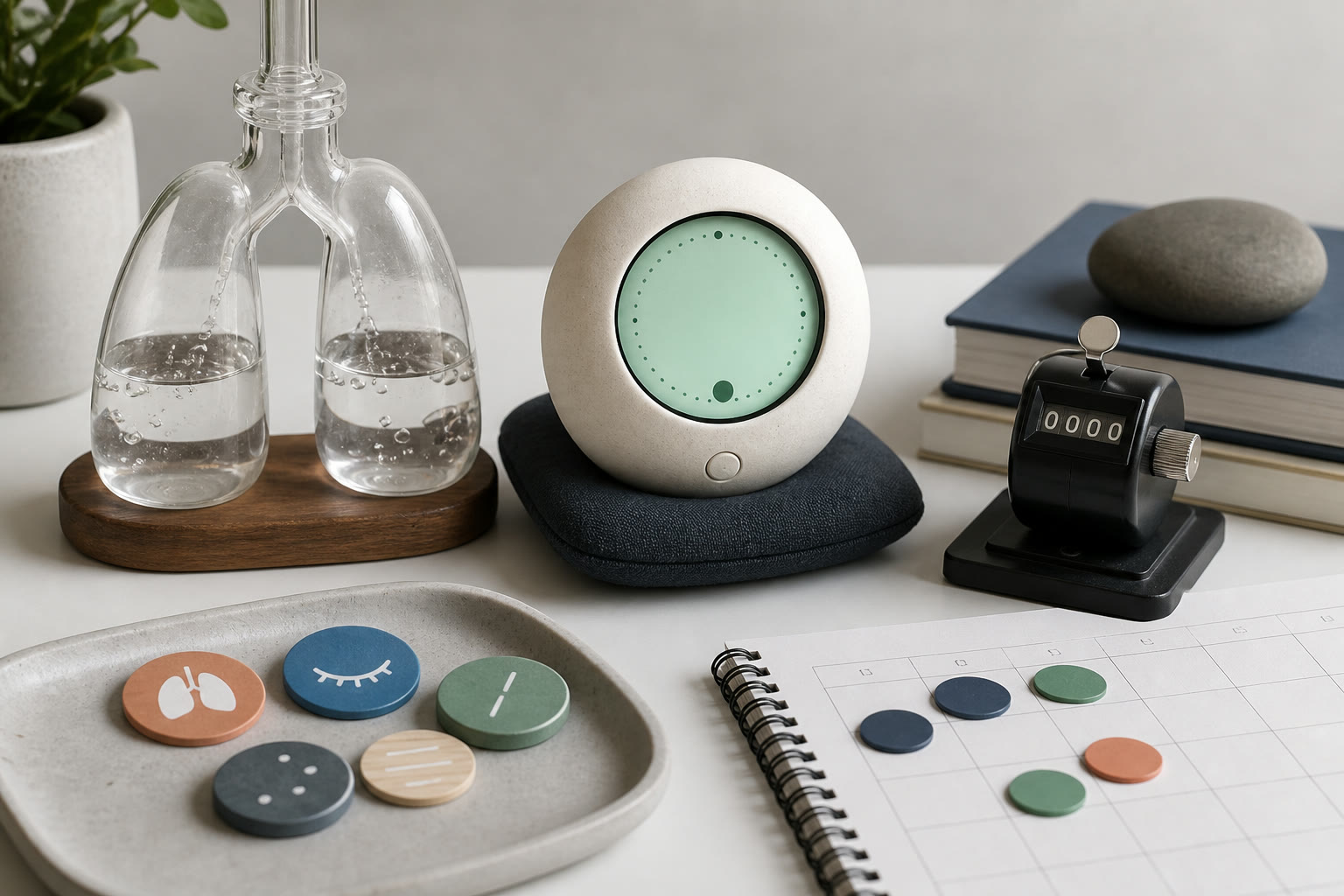
Breathing and blinking counters use different exposure time. Breaths continue during sleep, while blink estimates should normally use waking time. Both remain assumptions rather than recovered biological records.
Estimating breaths
Multiply elapsed minutes by a selected breaths-per-minute assumption. A rate of 16 produces 23,040 estimated breaths per day. The formula is simple enough for a visitor to reproduce with a calculator.
Real respiratory rate changes with age, activity, sleep stage, altitude, illness, emotion, and other factors. One number across decades is therefore an illustration of scale, not a respiratory history.
Estimating blinks
Blink estimates should begin with waking minutes rather than all elapsed minutes. If sleep is estimated at eight hours per day, the formula applies the selected blink rate to the remaining sixteen hours.
Blink frequency varies with attention, reading, screen use, conversation, environment, eye condition, medication, and measurement method. Published observations do not justify assigning one universal personal rate.
Why the counters should remain separate
Breathing continues during sleep, although the rate and pattern can change. Spontaneous blinking largely belongs to waking behavior. Applying both rates to the same lifetime minutes silently overstates the blink total.
A good result shows the exposure time beneath each total: elapsed time for breaths and estimated waking time for blinks. This teaches more than a single spectacular number.
How sleep assumptions affect blinking
Changing average sleep from seven to nine hours reduces estimated waking time by two hours per day. Across decades, that produces a large change in blink totals even when the blink rate stays fixed.
The sensitivity is useful. It demonstrates how assumptions drive the output and why extra digits do not create certainty. The input should be adjustable and displayed with the result.
What the calculation cannot tell you
The counters cannot evaluate breathing quality, oxygen levels, eye health, fatigue, screen strain, sleep disorders, or neurological conditions. They do not connect to a sensor unless the interface explicitly says so.
Clinical questions require validated measurement and qualified interpretation. A page should never compare a visitor's estimate with a disease threshold or imply that a larger or smaller lifetime total is healthier.
Sharing the estimate clearly
Label both totals estimated, include the chosen rates, and explain that the blink counter uses waking time. A short methods line prevents the animation from being mistaken for live body monitoring.
Share the exercise without unnecessary identity details. An age range and assumptions can demonstrate the method; the exact birth date can stay private unless it is essential to the recipient.
Breathing rate needs an activity context
Breaths per minute change with age, sleep, exercise, altitude, emotion, illness, and measurement conditions. A resting rate from a reference source is not automatically a full-day lifetime average. Multiplying one selected rate by every elapsed minute produces an understandable estimate, but it cannot recover periods of exercise, infancy, sleep, or respiratory illness.
A better interface names the assumed average and allows the user to explore a range. Separate waking and sleeping scenarios can add context if the inputs remain simple. Do not imply that adjusting a slider evaluates lung function. The model answers how totals scale under an assumption, not whether a person's breathing is normal.
Blinking depends on waking time and attention
Blink rate varies with reading, screen use, conversation, environment, fatigue, and eye comfort. People also blink far less during sleep, so multiplying every lifetime minute by a waking blink rate substantially overstates the total. Estimate waking minutes by subtracting sleep time before applying the selected blink rate.
Even during waking hours, a single constant remains a simplification. A transparent result can show estimated waking time, assumed blinks per minute, and the multiplication used. It should avoid claims about dry eye or visual health, because those require symptoms, examination, and context beyond a date-based tool.
Keep two counters separate
Breaths and blinks should not share one hidden rate or time basis. Breathing continues during sleep, while the blink estimate usually uses waking time only. Each result needs its own label, formula, unit, and assumption. Combining them into one body activity score would remove meaning and invite comparisons unsupported by the inputs.
For live counters, recompute from elapsed time rather than trusting animation intervals. Browsers slow background tabs, and a frame-based number will drift. The displayed increments can be animated, but the authoritative estimate should be current elapsed minutes multiplied by the selected rate and, for blinks, the modeled waking fraction.
Useful interpretation without medical claims
These totals are scale illustrations. They can help a reader understand how frequent ordinary actions accumulate over decades and how changing one assumption changes the output. They cannot measure the visitor, diagnose a breathing problem, assess screen strain, or replace advice from a qualified professional.
When copying or downloading results, include the assumed rates and average sleep setting. That information is more valuable than extra decimal places. Keep the full birth date private when an age or rounded elapsed period is sufficient, and use current health resources rather than a lifetime estimate when symptoms or urgent concerns are involved.
An example with separate time bases
Assume 30 years of elapsed time, an illustrative 16 breaths per minute, eight hours of sleep per day, and 15 blinks per waking minute. The breath model uses every elapsed minute, while the blink model uses roughly two thirds of those minutes as waking time. Applying 15 blinks to all 24 hours would overstate the blink estimate by about one half compared with that sleep-adjusted scenario.
This example also shows why the results should not be combined. The breath total and blink total arise from different behaviors and assumptions, and their numerical sizes do not indicate importance or health. Read each formula with its own rate and time basis, and change one assumption at a time when comparing scenarios.
For a reasonableness check, compare a very short interval that can be calculated by hand with a longer example using the same rates. Very large values should be rounded consistently, while the full rate and time basis remain visible. The interesting part is the scale, not a rapid animation or an unsupported claim of bodily measurement.
Reading the two estimates together
Keep the assumption directly beside each number. Breaths use all elapsed minutes, while blinks normally use estimated waking minutes, so changing the sleep setting should affect only the blink scenario. Different units help prevent the totals from being mistaken for one combined health measure.
Whenever a result is saved or shared, include the rates and time bases needed to interpret it. A detached total has little meaning because another set of plausible assumptions can produce a very different number. This context matters even though both figures remain illustrative estimates.
Key takeaway
Breaths and blinks require separate rates and time bases. Breathing continues during sleep, while a blink estimate normally uses modeled waking time. Keep both assumptions visible and change one at a time when comparing scenarios. The totals should never be combined into a health score or treated as measurements from the body. Their value is showing the scale produced by repeated rates over many years while keeping respiratory and eye-health questions outside the model.
Sources and further reading
These references support the calendar rules, cultural context, or public-data definitions discussed in this guide.
- NCBI Bookshelf: Vital Sign AssessmentClinical context for adult respiratory-rate measurement.
- NCBI: Spontaneous eye blink rateResearch context for variability in spontaneous blinking.
- CDC: About sleepGeneral sleep-duration context used to separate waking and sleeping time.